The Jawline Tension Trap: How Stress is Squaring Your Face (and the 2-Minute Release)

If you’ve noticed that your face looks wider at the bottom than it did five years ago, or if you wake up with a dull headache near your temples, you aren't just "aging." You might be trapped in a cycle of chronic jaw tension. In the US, where high-stress lifestyles are the norm, we are seeing an epidemic of "clenchers"—women who carry the weight of their world right in their masseter muscles.
The masseter is one of the strongest muscles in the human body relative to its size. Its job is to help you chew, but for many of us, it has become a 24/7 stress absorber. When you clench your teeth—whether at your desk, stuck in traffic, or during a difficult conversation—you are essentially putting your jaw through a heavy weightlifting session.

The Aesthetic Cost of Tension
Over time, like any muscle that is overworked, the masseter hypertrophies. It gets bigger, thicker, and harder. This leads to a "squaring" of the lower face, making the jawline look heavy and masculine rather than sculpted and lifted.
Even more frustrating? A tight jaw acts like a roadblock for your lymphatic system. It compresses the pathways that allow fluid to drain from your mid-face. This is often why women who struggle with jaw tension also struggle with persistent puffiness around the mouth and lower cheeks. You can’t have a snatched jawline if the muscles underneath are chronically shortened and inflamed.
The 2-Minute "Melt" Routine
To reclaim your facial shape, we need to move from "clenching" to "melting." This isn't about strength; it’s about neurological release. Try this simple sequence tonight:
1. The Mouth-Ape Opening
Slightly open your mouth and let your lower jaw hang heavy. Imagine there is a small weight attached to your chin. This instantly breaks the feedback loop of clenching and tells your brain that you are safe.
2. The Knuckle Roll
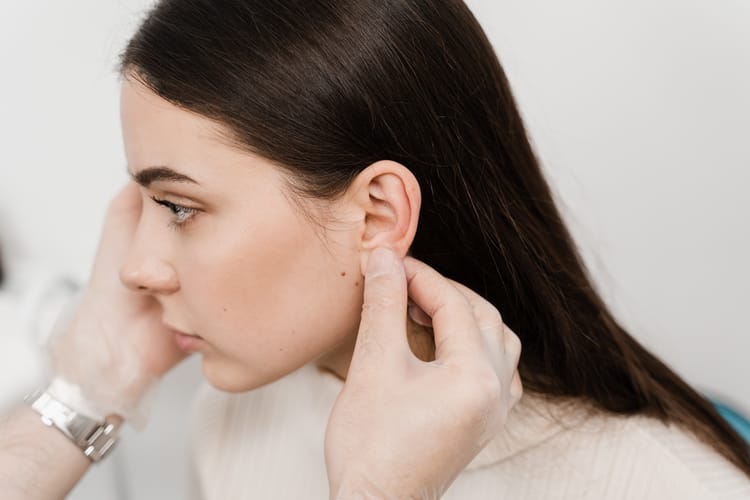
Find the "corner" of your jaw where the bone turns upward toward your ear. Place your knuckles there and apply firm, steady pressure. Slowly open and close your mouth while keeping your knuckles pressed in. You might feel a "crunchy" sensation or a dull ache—that is the fascia and muscle fibers beginning to release.
3. The Tongue Reset
Where is your tongue right now? If it’s pressed against your bottom teeth or the roof of your mouth with force, you are clenching. Gently rest the tip of your tongue on the ridge just behind your top front teeth, and let the rest of the tongue go limp. This is the "home" position for a relaxed face.
The Mind-Muscle Connection
The jaw is deeply connected to our nervous system. It is the first place we "armour" ourselves against the world. Understanding the neuromuscular link between jaw tension and posture shows us that we can't treat the face in isolation. A tight jaw often means a tight neck and a restricted breath.
When you release the jaw, you often feel a wave of relaxation through your entire upper body. It’s a holistic "facelift" that starts from the nervous system and works its way out to the skin.
Why This Wins Over Injections
Many women in their late thirties are offered Botox in the masseters to "slim" the face. While this works temporarily, it doesn't address why you are clenching in the first place. By using manual release and face yoga, you aren't just masking the symptom; you are retraining your body to hold less tension.
You’re regaining your natural, heart-shaped or oval face by simply allowing the muscles to return to their resting length.
Your Action Step for Today
Set a "jaw check" alarm on your phone for 3:00 PM. When it goes off, notice if your teeth are touching. If they are, take a deep breath, drop your jaw, and do thirty seconds of knuckle rolls.
A sculpted face isn't just about what you do in front of the mirror for five minutes; it's about what you stop doing for the other twenty-three hours of the day.